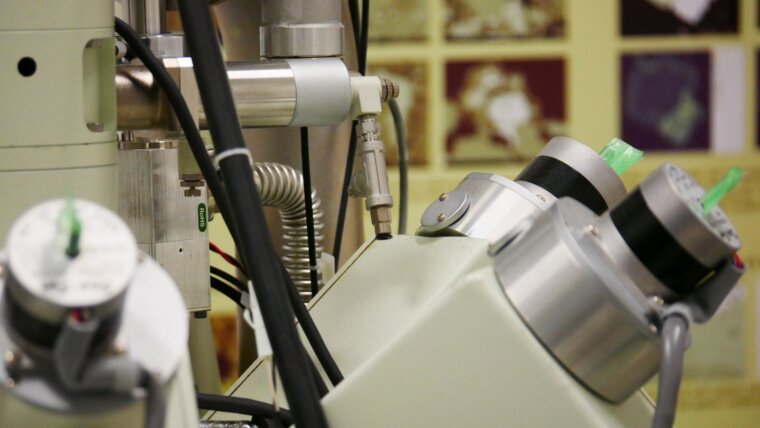
Im Fokus: WDX-Spektrometer
Allgemeine Informationen
Alle natürlichen und synthetischen Festkörper werden auch durch ihre individuelle chemische Zusammensetzung definiert. Mit Hilfe der Elektronenstrahlmikrosonde lassen sich Veränderungen und Variationen der Zusammensetzung eines Festkörpers im submikroskopischen Bereich abbilden und analysieren. Durch die elektronenmikroskopische Auflösung in Kombination mit der quantitativen Röntgenspektroskopie gelingt es, Festkörpereigenschaften und Chemismus im µm-Bereich zu korrelieren. Die Elektronenstrahlmikrosonde zeichnet sich dabei durch reproduzierbare und sehr genaue chemische Analysen aus, die sowohl in den Geowissenschaften, aber auch in der Chemie, Werkstoffforschung und Industrie sehr gefragt sind.
Die Elektronenstrahlmikrosonde dient der
- quantitativen und qualitativen Analyse von Haupt- und Spurenelementen (> 100ppm / 0.01 wt.%)
- Festkörperanalyse aller Elemente ab Sauerstoff bis Uran
- Oberflächenabildung (Elektronenbilder und Kathodolumineszenz)
- Erzeugung von Elementverteilungsbildern und Konzentrationsprofilen
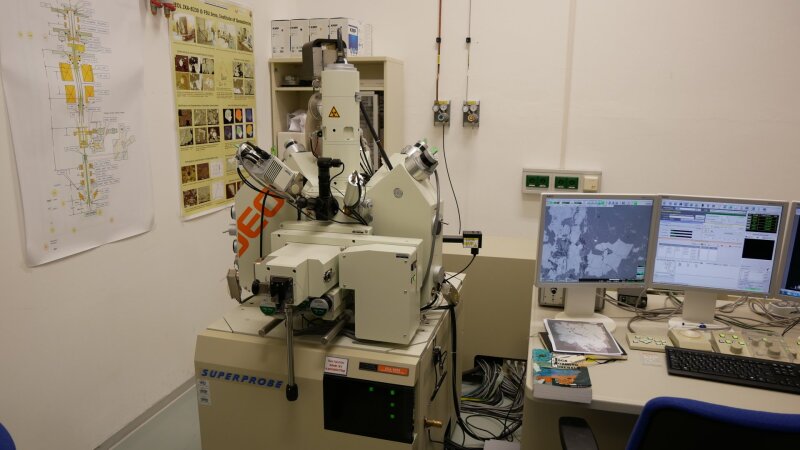
JEOL JXA-8230
Foto: Stefan Kiefer-
Vorteile und Probenformate
Vorteile und Proben
Die größten Vorteile sind, dass es sich um eine zerstörungsfreie Analysemethode handelt und in-situ kleinste Probenmengen im µm-Bereich analysiert werden können.
Proben
- Standardmäßig polierte Dünn- und Anschliffe
- Dünnschliffe im Format ca. 28 x 48 mm
- runde Anschliffe im Format 1'' (25.4 mm)
- runde Anschliffe bis 30 mm
- beliebige Probenformate nach Rücksprache möglich
Die Probenoberfläche muss poliert sein und wird vor der Messung gereinigt und mit Kohlenstoff bedampft.
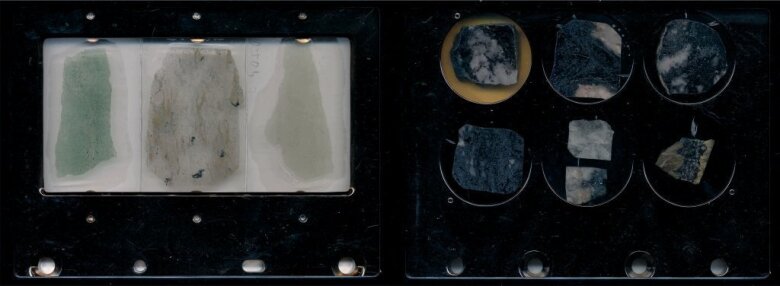
Probenhalter für drei Dünschliffe und sechs Anschliffe
Foto: Stefan Kiefer -
Auszug aus der Nutzerordnung
Im Auszug der Nutzerordung EPMApdf, 838 kb sind Ausstattungsinformationen, mögliche Entgelte sowie weitere Informationen enhalten.