Neue Publikation über die Verwitterung von Erzlagerstätten
Die Verwitterung von Lagerstätten führt zur Bildung von neuen Mineralen. Wie und unter welchen Bedingungen diese entstehen und was man daraus "lesen" kann, zeigt diese neue Publikation.
Meldung vom:
Weathering of ore deposits generates mineral assemblages that correspond to the conditions under which they formed. Deciphering these conditions from the minerals is essential equal to "reading" the record which is left long after the weathering took place. It can help to understand weathering sites where the "reading" is not so simple, for example because the assemblages are too simple. In the latest contribution, we investigated a rich assemblage of weathering minerals at the site Zimna Voda in Slovakia. By a detailed study, we found that weathering started under strongly acidic conditions and slowly proceeding in the direction of mildly acidic to almost neutral conditions. This change was also decisive for the fate of some of the elements, for example antimony or bismuth. They behave differently than at many other sites which do not develop prominently the strongly acidic state. For more information, see https://doi.org/10.1180/mgm.2023.75Externer Link
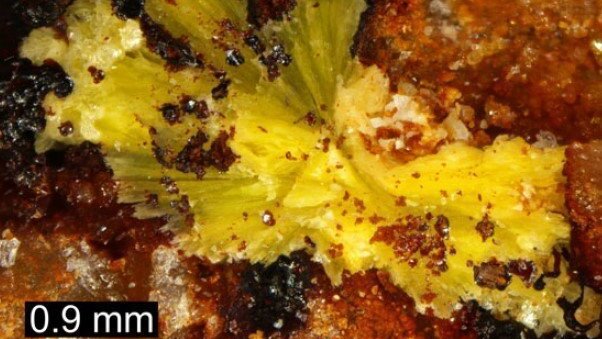
Photograph of secondary uranium minerals from the studied site.
Foto: S. Ferenc