Meldung vom:
3D Electron Diffraction as a Powerful Tool to Study the Earliest Nanocrystalline Weathering Products: A Case Study of Uraninite Weathering
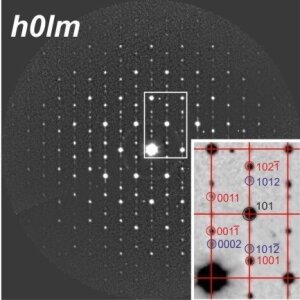
Eines der reziproken Beugungsbilder, dass zur Strukturaufklärung der U-Nanopartikel benutzt wurde
Foto: Gwladys SteciukAt the beginning of weathering of ore minerals, tiny particles of nanometer size are formed. They influence to a large degree what happens later in the weathering process. On the other hand, they are difficult to analyze and describe because of their small size. In this work, we specifically investigated the earliest stage of uraninite (UO2) weathering and learned how does uranium behave when it is introduced into the environment. The key method applied in this work is precession electron diffraction. This innovative method allowed us to determine crystal structure of the weathering nanoparticles and draw ties between them and the later micro- and macrocrystals that store uranium at mining sites. The results of this work have implications for the understanding of the long-term fate of radioactive waste from nuclear power plants.
More information can be found at https://pubs.acs.org/doi/full/10.1021/acsearthspacechem.1c00386Externer Link