Examiner's handbook
Procedures and instructions for examiners and input representatives of the Faculty of Chemistry and Earth Sciences
Brochure for new teaching staff
The Office of the Dean for Student Affairs|Dean for Student Affairs Office has summarised important information for (new) teaching staff in a brochure. It contains tips and information not only on examinations, but also on other topics relevant to teaching.
Download the brochureThis link requires a loginde
The responsibility of the Office for Student Affairs and Examinations of the Faculty of Chemistry and Earth Sciences (CGF) extends to the Bachelor's and Master's degree programmes as well as the teaching subjects* Chemistry & Geography of the Faculty.
(* without State Examination - the State Examination Office for Teacher Training is responsible for this)
The Academic Office for Student Affairs and Examinations (ASPA) is responsible for the supplementary subjects B.A. Geology and Human Geography as well as the accompanying teacher training programme.
Information on current examination procedures is published on the website of the Office for Student Affairs and Examinations of the CGF. The FAQ section "Frequently asked questions" contains important information about the degree programme and examinations. There is a separate "Applications, forms and templates" subject) area|field for students .
Exam-related concerns that deviate from the regular regulations and procedures (e.g. cases of hardship, extensions of writing time, exam withdrawals, etc.) must be reported or applied for by students to the CGF Examinations Office! Coordination with the responsible examiner is generally not sufficient! In such cases, please refer students to the Examinations Office of the CGF!
If students enquire about a matter that is not regulated in this Examiner's Guide, please consult the Examinations Office beforehand.
For forms and applications, students are asked to use the Service DeskExternal link. All other concerns and questions can be submitted by students and university staff at any time by e-mail to Office for Student Affairs.Chemgeo@uni-jena.de.
Consultation hours are by telephone appointment:
All degree programmes at the CGF are assigned to an Examinations Committee . This committee ensures compliance with the provisions of the Examination Regulations, ensures that examinations are conducted properly and decides upon formal requests from students and appeals|ruling|judgements made in examination procedures.
Information on the individual Examinations Committees and their members and deputies de can be found on the website.
(Full) proposals to the Examinations Committee must be submitted via the Examinations Office.
In order for students to be able to register for courses and examinations, you as a teaching staff member or examiner must ensure that your course|classes and examinations are fully entered in Friedolin, linked to modules and that examination records are complete.
If you notice that information is missing or incorrect in Friedolin, please add this to the "Examiner" or "Teaching staff" role or contact your department administrator:
The automatic course allocation(allocation of places) in the modules takes place at the latest by the beginning of lecture period (1st and 2nd allocation phase). It is recommended to use the automatic allocation of places. Teaching staff can admit additional students to the course|class manually at their own discretion. The status of students can be changed under "Enrolment information" → "Edit participants".
If there is a choice of assessment method in the module description or if you deviate from the assessed coursework and examinations in the module catalogue, please announce the assessment method and any examination prerequisites at the beginning of the course in writing via email to all students in the course.
You can find more information in the Friedolin Help CentreExternal link and in the WikiExternal link.
Lectures: Attendance is not compulsory in lectures. However, it is recommended that students attend regularly in order to better understand the subject matter and ensure academic success.
Other courses: In certain course, such as field trips, language courses, internships or practical exercises, compulsory attendance may be stipulated as a requirement for admission to the module examination. This is the case if the learning objective can only be achieved through regular attendance. The attendance requirement and other requirements for regular and/or active participation are set out in the respective module description. In such cases, the learning objective must give reasons why attendance is mandatory.
Attendance certificates: As a rule, students at the University of Jena are not required to provide certificates of attendance for course|classes.
If you have any questions , please contact the Examinations Office.
Module leaders and teaching staff responsible for the module are examiners in the associated module examinations without special appointment. Oral examinations are usually conducted by an examiner and an expert assessor.
Please familiarise yourself with the respective Study and Examination Regulations! These regulate the framework for the proper course of study as well as the examination procedure in the respective degree programme (Bachelor's, Master's, teaching degree) and corresponding deadlines.
All Study and Examination Regulations are available in Hanfried. de
The examination dates are collected in the department and then entered centrally in the Examinations Office.
Please ensure that your examinations are entered in Friedolin in their complete form (examination number, examination date, examiner) and are linked to the corresponding modules .
If you notice that examination data records (dates, examiner) are not or incorrectly stored in Friedolin, please contact the responsible department administrator:
The examination dates stored in Friedolin are generally binding. The individual examination date, e.g. for oral examinations, must be communicated to the students and the Examinations Office (preferably in writing).
Changes to examination dates (in Friedolin) after the start of the lecture period must be notified to the Examinations Office without undue delay and students must be informed in good time (at least 14 days before the examination).
Two examination dates must be provided per semester. If students do not attend the first examination date (e.g. due to illness, non-attendance, etc.), they must be registered in Friedolin for the retake date . The retake date is binding for students and must be attended.
Exam registration for module examinations (and partial module examinations) is carried out independently by students via Friedolin at the latest 10 weeks after the beginning of lecture period.
In the case of examinations during the semester, the examination must be registered before the first examination! Please inform the students explicitly about this. Please do not accept any coursework if no exam registration has yet taken place.
Students will receive an automatically generated email sent by Friedolin to their URZ account upon successful registration (there is a retention obligation).
If students are unable to register for exams via Friedolin, they must contact the Examinations Office by the end of the exam registration period at the latest. Please always refer students to the Examinations Office and do not accept any registrations or cancellations yourself!
Exam registration via Friedolin is not possible if, for example
In these cases, please refer students to the Examinations Office.
Subsequent exam registration is generally not possible. The only exceptions are project modules and work placements.
Exam registration for the 1st examination attempt constitutes an examination obligation. In the event of withdrawal or failure in the 1st attempt, there is an automatic examination obligation for the 2nd attempt. This must be taken at the next possible date.
Please check in good time before the examination whether all students registered for the examination fulfil the requirements for taking the examination (e.g. examination prerequisites, see module descriptions).
If students fulfil all requirements or if no requirements are defined in the module descriptions, they must be admitted to the examination. (Admission is preset in Friedolin, so it does not have to be granted by the examiner).
Students who do not fulfil the requirements are not to be admitted to the examination. Proceed as follows:
If there is no declaration of independence in online examinations (as a rule, the declaration must be submitted or uploaded in Moodle directly before the examination, otherwise you will not be forwarded to the examination), you will record a non-admission in Friedolin.
Students can deregister from a module examination in Friedolin up to 10 weeks after the beginning of lecture period at the latest and applies to both the 1st attempt and the 2nd attempt.
After this period, cancellation is no longer possible (exception: block courses - here cancellation is possible until the middle of the course at the latest). Students can only apply to the Examinations Office for withdrawal if there are valid reasons (e.g. illness).
If a student contacts you with a request to enrol for or withdraw from an examination, please refer them to the Examinations Office.
Please check the exam registrations before the examination. Only those students who have registered for the examination and are admitted are authorised to take part in the examination. To compare the admitted and participating students, create an exam participant list via Friedolin.
Please clarify before the examination begins:
If the examination has to be cancelled or postponed at short notice (e.g. due to illness of the examiner), please inform immediately
Students who are not registered for the examination cannot take part in the examination.
Only in absolutely exceptional cases, if the student was prevented from taking the exam registration during the registration period and up to the day of the examination (e.g. due to hospitalisation), could participation in the examination be granted. In such cases, please do not give a grade to the student until the registration status has been clarified by the CGF Examinations Office.
In the event that examinations are taken without registration, there is no right to have the work recognised.
(Invigilated) written examinations|exams must take place under the supervision of a competent person, regardless of whether the exam takes place in person or online. This competent person does not have to be the teaching staff/examiner.
In the case of written examinations, the proper procedure must be confirmed by the invigilator in an invigilation protocol :
The supervision record must be kept in the department (see Storage of examination documents).
Any perceived disturbance (e.g. noise, cold, heat, etc.) must be reported by the examinee during the examination and noted in the invigilator's record .
The invigilator must have the opportunity to rectify the fault. If this is not possible, appropriate compensation must be provided. The decision|ruling|judgement is made by the supervisor.
If the disruption cannot be adequately compensated for, the (invigilated) written examination|exam must be cancelled. All students must be informed immediately. There will be a retake. In this case, please inform the CGF Examinations Office immediately.
Technical problems in online examinations during the examination: If there are technical problems in online examinations that only affect individual students, this must be reported by the students to the examiners without undue delay during the examination and documented (e.g. by taking screenshots of the error message). Subsequently, the student must notify the CGF Examinations Office without undue delay, including the relevant proof|evidence.
Once the grades have been announced, complaints are excluded.
If a student states during the examination that he/she is inability to take the examination , the inability to take the examination must be reported to the CGF Examinations Office immediately after the examination and proven within 3 days by means of a medical certificate . A doctor must be consulted without undue delay.
All incidents must be noted in the examination record.
If deception is detected: see "Detection of deception"
If a student requests an individual examination date,
If a student wishes to change the assessment method, this is possible upon formal request to the Examinations Office with confirmation from the examiner if the module description allows for a different assessment method.
The assessment method may be changed between the first and second examination attempt, provided this is stated in the module description. However, it should be noted that the second examination date is not the second examination attempt for all students. Students who were ill on the first date or who have a recognized|to credit withdrawal must be given the same assessment method as the examinees on the regular first examination date. If you have any questions, please contact the CGF Examinations Office.
If the deadline for deregistration from the examination has expired and students are unable to take the examination for valid reasons (e.g. illness/accident), withdrawal from the examination must be reported to the Examinations Office without undue delay (see Examination assessment) and the reasons must be proven within 3 working days (e.g. certificate of incapacity to take the examination or similar).
If students declare at the beginning of the examination that they are unable to take the examination,
In the case of an approved withdrawal, the Examinations Office will adjust or reset the counting of the examination attempt.
The approved withdrawal is noted in Friedolin with "RAT" (withdrawal with certificate) or "RAN" (recognised withdrawal) and the attempt is deemed not to have been made.
Students are obliged to take the examination on the next possible examination date (as opposed to exam de-registration). If the subsequent attempt falls in a different semester, the student must register for the examination on a self-employed basis via Friedolin. In this case, the course|class should be proven|to register for|to take again.
In the event that deadlines or submission dates cannot be met by students for reasoned reasons, a new deadline can be agreed by the examiners with the students (illness, school placement semester in the teaching profession).
Withdrawal is generally not possible for seminar papers (to be written at home).
Grading of coursework and examinations must be assessed as soon as possible and the result must be announced with the grade entry in Friedolin.
Notification of grades for examinations: no later than 14 days before the resit date. If the deadlines between the announcement of grades and the resit date cannot be met, the resit date must be postponed or rescheduled. Failure to meet this deadline may result in the student contesting the examination.
For final year thesis (B.Sc., M.Sc.), a maximum review period of 4 weeks (B.Sc. Chemistry and Geography, M.Sc. Chemistry, Chemical Biology, Chemistry-Energy-Environment) or 6 weeks (B.Sc. Biogeosciences and Geosciences, M.Sc. Chemistry of Materials, Biogeoinformatics, Geosciences and Environmental and Georesource Management) applies.
Each module examination must be assessed (it can be posted in Friedolin retroactively for a maximum of 2 semesters). The announcement of grades/assessments to students takes place via Friedolin for written coursework and examinations.
Please log in to Friedolin in the role of "Examiner" .
Go to the menu item "Grade posting" and select the desired semester, the examination date and, in the next step, the examination. You will now be shown a list of all exam participants.
Please enter the examination results in the "Assessment" column as follows (see image below):
Please do not leave any assessed coursework or examinations open, but always enter a grade or a note, even if students have reported that they have, for example, requested a withdrawal at the Examinations Office (see "Non-delivery") or may have been de-registered in the meantime (see "De-Registration)
If no declaration of independence is submitted with seminar papers (to be written at home), the work will not be assessed until the declaration is submitted.
If bookings fail, a corresponding message will be displayed. In this case, please contact the Examinations Office of the CGF.
If it is not possible to post grades in Friedolin, please contact the Examinations Office.
For examinations in the 2nd/3rd attempt, an assessment must always be carried out by a second examiner (4-eyes principle).
Inspection of the examination documents must be guaranteed (see Inspection)
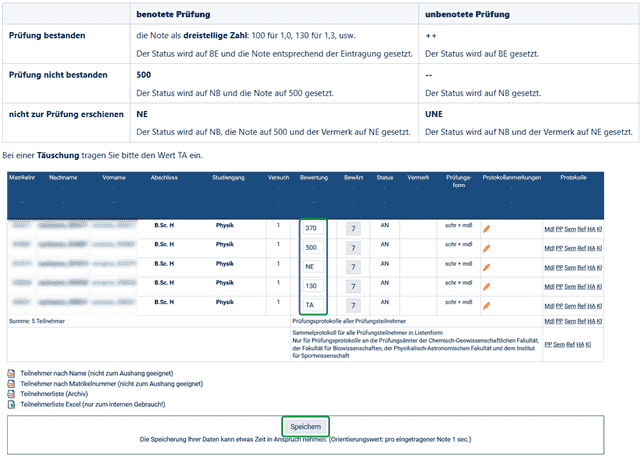
The screenshot shows how examiners can enter the examination results in Friedolin.
Screenshot: Carolin Thiel; FriedolinThere must be at least 2 weeksbetween the announcement of grades (usually by posting in Friedolin) and the resit date
If the grade is posted too late, the resit date must be postponed. Please contact the Examinations Office for this.
If registered students have not taken part in the examination or have not submitted a written assignment within the period stipulated, please enter "NE" (not appeared) in the grade field; a grade of 5.0 will be generated automatically.
If students notify you of an exam withdrawal due to illness, please extend the submission deadline on your own responsibility, see also Writing time extensions.
If you discover a possible deception during the (invigilated) written examination|exam, check the facts more closely:
If you suspect deception in seminar papers (be written at home), first document your suspicion of deception (what led to your assessment, did you use software, etc.).
The student should be heard. Invite him/her to a hearing for this purpose: In the invitation, state that you suspect plagiarism.
If you maintain your finding of deception after hearing the student, enter the note "TA" in the "Grade" field in Friedolin (Friedolin automatically generates the grade 5.0 in the background).
Give reasons for the attempted cheating in the examination record in short form.
Document the deception in detail for your own records (for later appeal|objections or legal proceedings).
If a deception occurred in the 1st attempt, the student still has the right to take an examination in the 2nd attempt.
Repeated deceptions can be penalised by the Examinations Committee in accordance with the Examination Regulations (e.g. by exclusion from examinations). The requirement is that the deceptions have been recorded by the examiner(s) by means of a TA note in Friedolin.
Stamp the collective record with an institute stamp and sign it.
If it is a 2nd or 3rd examination attempt, the performance must be assessed by a second examiner and the examination record must be signed by both.
Please send the transcripts to the CGF Examinations Office as soon as possible.
If you are no longer able to enter a grade, please contact the Examinations Office directly.
There is an examination obligation for students who do not pass the 1st attempt.
As the examiner , you are responsible for registering students for the 2nd examination attempt (alternatively, the respective entry representative; see instructions under Help Centre/Manual in FriedolinExternal link).
If registration is not possible, please contact the CGF Examinations Office immediately.
For (invigilated) written examinations/oral ex aminations, the regular resit date applies as set at the beginning of the semester. There must be at least 14 days between the announcement of the grade and the date for the second attempt.
For seminar papers (to be written at home ), there is a revision period of at least four weeks after the grade for the first attempt has been announced.
If students fail the 2nd attempt (for teacher training, Geography degree programmes, Biogeosciences) or 3rd attempt (Chemistry, Geosciences), the respective module is considered irrevocably failed ("EN").
The examination record must be sent directly to the Examinations Office of the CGF, as the notification of final failure will be issued on this basis.
Students of the subjects Teacher Training, Geography and Biogeosciences have the opportunity to apply for one further examination attempt per subject at the Examinations Office(unjustified/unconditional third attempt). This must be submitted to the Examinations Office within 6 weeks of the announcement of grades. One unjustified/unconditional third attempt per subject is approved once.
Additional hardship applications for a further examination attempt can be submitted by the student to the Examinations Office within 3 months (teaching degree) or 6 weeks (Bachelor's/Master's degree) of the announcement of grades and must be given reasons (valid and irrefutable reasons).
If the examiner has entered an incorrect grade in Friedolin, a grade change record must be completed. To do this, please click on the grade of the respective student in Friedolin, the grade change protocol will open (max. 2 semesters retrospectively). Please send this to the Examinations Office immediately.
Changing grades: Once grade entries have been saved, they can no longer be changed by the examiner or input representative, but only by the Examinations Office. If there is a need to change grades, please click on the grade to be changed. A change log will open, which you should fill in and send to the relevant Examinations Office.
In your own interest,give reasons for the assessment in the examination documents in as much detail as possible.
It must always be possible to inspect the grading of coursework and examinations. It is sufficient for the examiners to schedule a central appointment for all candidates before the resit examination; alternatively, you can provide the student with a copy of the grading of coursework and examinations, including the assessment.
The allocation of points or the marking scheme should be made transparent. The student should be given the opportunity to understand the assessment as clearly as possible.
An evaluation discussion can be held for seminar papers ( to be written at home) .
If students do not agree with a grade/do not understand the assessment, they can ask the examiner for a so-called reconsideration procedure , giving reasons in writing. The student should contact the examiner directly for this, but can alternatively contact the Examinations Office.
The examiner must respond in writing to the student's comments as part of the reconsideration procedure.
If the examiner maintains the previous assessment, the procedure is concluded. The student must be informed of this in writing.
If the examiner arrives at a different assessment in the reconsideration procedure, the grade change record must be completed in Friedolin and sent to the Examinations Office.
A copy of the complete documents and comments from the reconsideration procedure will be sent to the CGF Examinations Office.
The collective/examination records must be forwarded to the Examinations Office of the CGF as soon as possible.
The examination documents (assessed coursework and examinations, supervision record, reasons) remain with the examiners, please keep them in the department/institute until the retention period expires (up to 1 year after graduation).
The Study and Examination Regulations regulate the completion time and scope of final theses.
A final year project|thesis|dissertation can also be admitted as a group project if the contribution of the individual student to be assessed as grading of coursework and examinations is clearly distinguishable and assessable due to the specification in sections or other objective criteria that enable a clear delimitation. The basis for assessment is the respective contribution of the student.
The thesis is generally written in German (exceptions are possible - see "Registration of the final thesis"). In degree programmes taught in English|English-taught degree programmes, the thesis is written in English. A summary of the thesis must be included in German.
Final year projects|thesis|dissertations are assessed by two examiners , one of whom should be a university lecturer.
In exceptional cases , an external second assessor may be appointed by the responsible Examinations Committee. The second assessor should have at least one degree above the qualification to be achieved and must be approved as suitable by the first assessor. The Examinations Office will advise students on the specific requirements upon request.
The final thesis can be applied for by students using the following form via the Service Desk at the Examination Office of the Faculty:
There is no registration in Friedolin.
Both assessors must signthe student's registration form and stamp it with the institute's stamp .
If the final year project|thesis|dissertation is to be written in a language other than German, this must be agreed and approved by the assessment|assessment report|reviewers. A German summary must be added in any case.
Students must be enrolled|to matriculate at the time of registration of the final year project|thesis|dissertation.
For the registration of the final year project|thesis|dissertation, the requirements defined in the Office for Student Affairs and Examinations must be fulfilled; this is checked by the CGF Examinations Office; in particular
Students submit their final year project|thesis|dissertation to the CGF Examinations Office .
The student must ensure that the submission deadline is met .
The Examinations Office checks the thesis for formal completeness (e.g. declaration of independence).
The Examinations Office then sends the final year project|thesis|dissertation to the respective assessors (if necessary via the institutes) and requests an assessment|assessment report|review.
The assessment|assessment report|review must be completed within 4 weeks (B.Sc. Chemistry and Geography, M.Sc. Chemistry, Chemical Biology, Chemistry-Energy-Environment) or 6 weeks (B.Sc. Biogeosciences and Geosciences, M.Sc. Chemistry of Materials, Biogeosciences, Geoinformatics, Geosciences and Environmental and Georesource Management) on the basis of the print or digital version sent by the Examinations Office.
Essential contents of an assessment|assessment report|call for research|call for applications|review: Name and preferably student ID number of the student, title of the final year project|thesis|dissertation, assessment in grade and written out, date of assessment, signature, preferably institute stamp.
Each assessment|assessment report|review carries out its own assessment.
If the final year project|thesis|dissertation is not passed, each assessor must write an independent reason.
Please send the assessment|assessment reports|reviews to the Examinations Office within the assessment deadline, where the grades will be recorded.
The student is entitled to view the assessment|assessment report|thesis|review.
As long as both assessment|assessment reports|reviews are not available, no final documents (examination certificates etc.) can be issued to the student. Prompt submission is therefore important.
If a third reviewer is required, the third reviewer is appointed by the Examinations Committee.
The Examinations Office sends the final year project|thesis|dissertation to the third-party assessor with a request for assessment - regular procedure (see "Assessment").
The final year project|thesis|dissertation must be kept in the department in accordance with the retention periods for at least 1 year after graduation.
An appeal|objection by a student can only be submitted to the CGF Examinations Office on the basis of an appealable decision (usually issued by the Examinations Office or the Examinations Committee) and within the appeal period .
No appeal|objection can be lodgedagainst an individual examination grade (module examination and final year project|thesis|dissertation) or similar (the issuing of an examination grade does not constitute an administrative act). See also "Complains against valuation".
In the context of appeal procedures, it may be necessary for the examiners to provide relevant facts and circumstances (reasons for the grading, reasons for the finding of cheating, communication process, etc.). The Examinations Office of the CGF will contact you in this regard and, if necessary, ask you to provide additional information.
As part of the appeal decision, for which the Examinations Committee is responsible, the examiners will be asked to attend a meeting of the Examinations Committee as a guest if necessary. The relevant Examinations Committee decides on the appeal|ruling|judgement based on the reasons provided by the student and the examiner.
If students or their legal representatives request access to files as part of appeal procedures, the official examination file (including examination transcripts and notifications) can be inspected at the CGF Examinations Office. If access to written examinations is requested, the Examinations Office will refer you to the respective examiners. There, access to examination documents must be requested by the student or the lawyer and guaranteed by the examiners.
Documents can also be made available digitally if the lawyer agrees to this. The Examinations Office is available for questions and coordination requirements.
Study periods as well as coursework and examinations completed at another domestic or foreign state or state-recognised institution of higher education are to be credited if the university cannot prove any significant differences with regard to the acquired competences (learning outcomes). The recognition of prior learning|credit transfers must be determined by the Examinations Committee in consultation with the module leaders.
In the Examinations Office, the recognised|to credit achievements are entered in Friedolin (note "AK", also visible to students) and the subject semester classification (in the event of a change of university or resumption of studies) is carried out.
Deregistration|removal from the register of students does not release you from the examination procedure (bindingly registered examinations).
Exception: If the examination attempt is after the date of de-registration, it no longer has to be taken. If students do not appear for the examination or do not hand in the grading of coursework and examinations, please enter an NE (not appeared, see also "General information on assessment/booking").
Grading of coursework and examinations by students who de-register|remove from the register of students shortly after the examination dates must still be assessed and recorded.