How can cultural assets be protected in emergencies?
Collection managers at the University of Jena discuss with security expert Ralf Seeber

Published: | By: Katja Bär
Source article
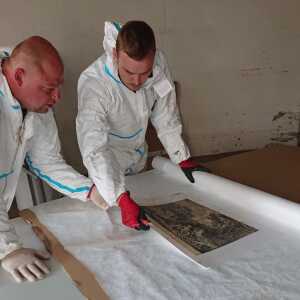
Examination of a print after its recovery from the depot of the Ahrweiler City Museum collection following the 2021 flood disaster in the Ahr valley.
Image: Sebastian SchlinkeMillions of scientific objects are stored in the collections of Friedrich Schiller University Jena: fossils millions of years old, seismograms, historical microscopes, ancient Oriental cuneiform tablets, botanical specimens, medical models and moulages, meteorites and tektites, prehistoric jewellery and antique vases. They are indispensable for research and teaching—and at the same time part of our cultural heritage. But how can these treasures be effectively protected from vandalism, fire or weather damage?
This question will also be addressed by the more than 30 collection managers at the University of Jena on 11 December. They have invited an external expert to their current meeting: Ralf Seeber, former chief fire officer of the Weimar professional fire brigade and now »emergency network consultant« of the Kulturrat Thüringen e. V. (Thuringia Cultural Council), is one of Germany’s leading experts in the protection of cultural assets.
»Our collections are of inestimable scientific value—but they are also vulnerable to external threats«, emphasizes the Vice-President of the University of Jena, Prof. Dr Bärbel Kracke. »This is why it is important to realistically assess risks and take precautions to ensure that this knowledge and cultural heritage is preserved for future generations.«
The meeting between the Vice-President and the collection managers will focus on emergency and disaster management: How can objects be secured, how can a rapid response be ensured in an emergency and what preventive measures are appropriate? Seeber will outline the key challenges in a keynote speech and then discuss them with the Jena collection managers.
The University of Jena has more than 40 scientific collections with millions of objects. Many of them are unique and form a valuable basis for current research, innovative teaching and the transfer of knowledge to society. They characterize the University’s buildings, are on display in permanent and special exhibitions, or are accessible on request, for example in the Anatomical Collection, the » Bibliotheca Electoralis«, the Botanical Garden, the Ernst Haeckel House, the Goethe Laboratory, the Mineralogical Collection, the Phyletic Museum and Schiller’s Garden House.
A wealth of information can be found on the »Collection Portal« website. Among other things, you can research current and past exhibitions and a new »Object of the Month« is presented every month. Visit the »Collection Portal«: https: //sammlungen.uni-jena.de/External link