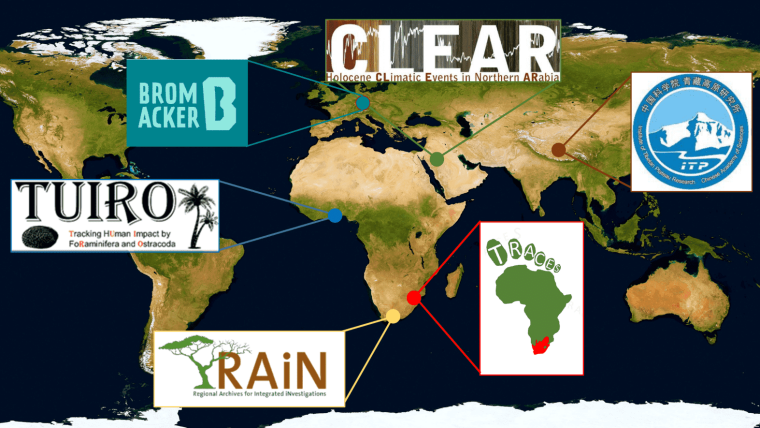
Unsere Forschungsprojekte
Paleontology
Our group investigates and teaches in the field of paleontology; the subject of this research are fossils. They represent important evidence about the history of the earth and the development of life. Fossils help us to understand the complex relationships between the biosphere, hydrosphere, geosphere and atmosphere, as well as processes occurring over long periods of time; thus, paleontology provides insights into our origins as humans and our responsibility for the Earth's ecosystems.
Paleontological research is about documenting fossil organisms and about reconstructing their way of life, and using them as indicators of the paleoenvironment, of diagenetic changes, and of the age of the rocks containing them. Our approach is primarily application-oriented, meaning that we use fossils and fossilizable organisms living today in paleoecology and paleoclimatology, environmental research, georisk assessment, geoarchaeology, and biostratigraphy. Our study areas are largely in Central Europe, the Mediterranean, Central Asia, western and southern Africa.
Our research is mainly micropaleontological. The taxonomic focus is on ostracodes (shell crustaceans), small crustaceans with a double-flap carapace of calcite, and foraminifera, usually shell-bearing unicellular organisms. Both are classic groups of micropaleontology and occur in virtually all waters in often large numbers and high diversity, with foraminifera usually restricted to the oceans. Ostracodes and foraminifera can be used to study aquatic sediments throughout the Phanerozoic, i.e., throughout Earth's history, which is well documented with fossils. For paleoecological studies, however, we also draw on other groups of organisms, such as molluscs, and collaborate with many research groups on an interdisciplinary basis. In addition to the numerous fields of application, this concerns shell chemistry, geochemistry and sedimentology. Our principal methods are therefore field work, sediment sample preparation, various imaging techniques (light microscopy, electron microscopy, microtomography and photogrammetry), chemical analysis and multivariate statistics.
We are convinced that paleontology within the geosciences has a great potential for knowledge transfer and communication of scientific knowledge due to its great popularity among the general public. We try to use this potential through active public relation work.
Team
-
Apl. Prof. Peter Frenzel
Learn more de
Peter Frenzel
Image: Peter FrenzelLehrstuhl Allgemeine und Historische Geologie
E-Mail: peter.frenzel@uni-jena.de
Tel.: +49 3641 9-48619
Fax: +49 3641 9-48622Raum H 110
Burgweg 11
07749 Jena -
Dr. Anna Pint
Learn more de
Anna Pint
Image: IGWE-Mail: anna.pint@uni-jena.de
Tel.: +49 3641 9-48724
Fax: +49 3641 9-48622Raum H310
Burgweg 11
07749 Jena -
Ella Quante
Learn more deInhalt
Active research projects in Jena
Revision der Systematik und Phylogenie der quartären und rezenten marinen podocopiden und halocypriden Ostracoda (Arthropoda, Crustacea)“ (VolkswagenStiftung 9B887) (gemeinsam mit N. Dykan)
2022 – 2023
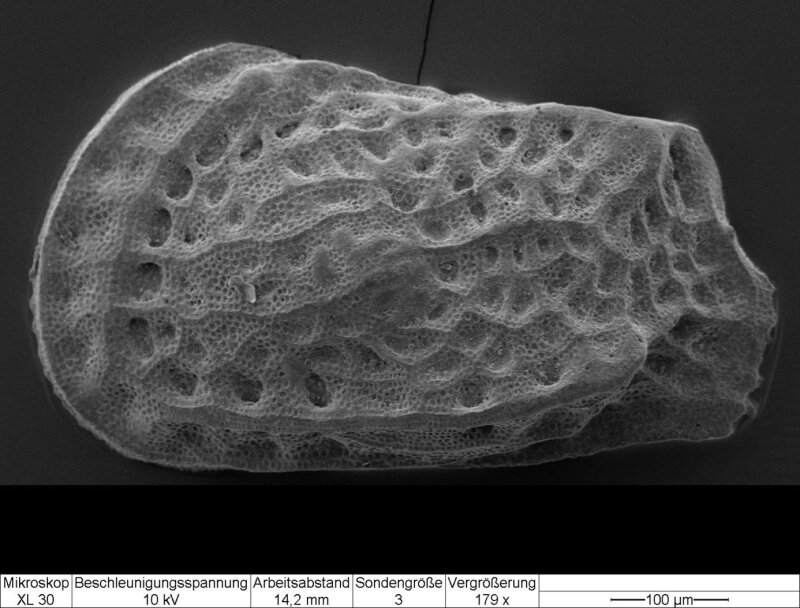
Ostracoda
Image: Thomas Daniel"Automated Identification of Ostracods" (Programme of the project-related exchange of persons Hong Kong 2022-2024) (DAAD 57601852) (together with M. Yasuhara)
2022 - 2023
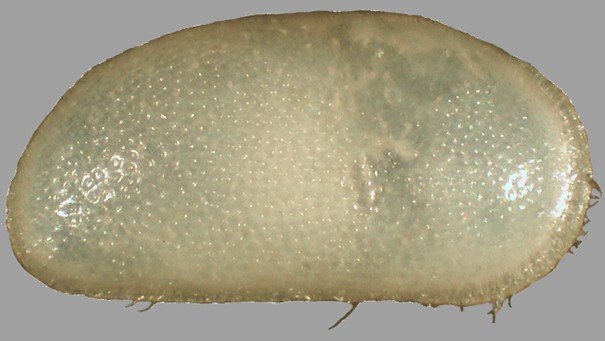
Automated identification of ostracods
Image: P. FrenzelBROMACKER: "Opening up science: New ways of science communication using the example of the research project Bromacker: Geology and Climate" (BMBF 01UO2002C) (together with C. Heubeck & T. Voigt)
2020 - 2025
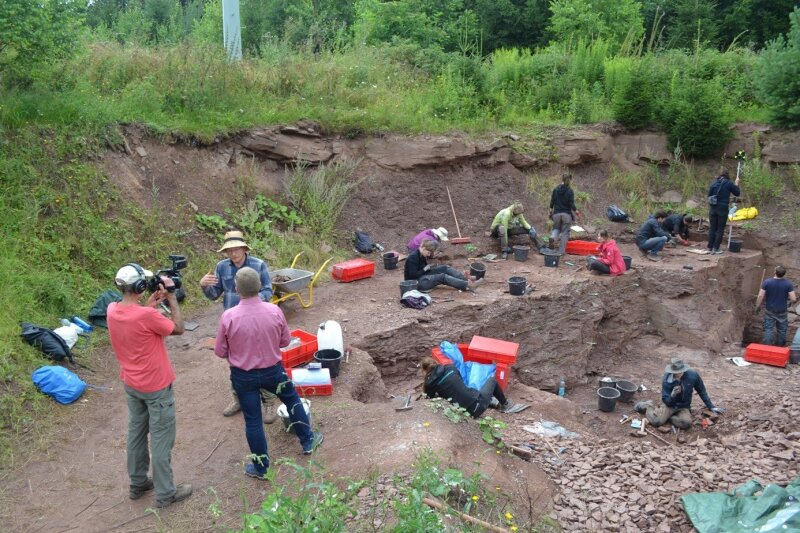
Paleontological excavation
Image: Frank ScholzeCompleted research projects in Jena
-
TRACES
"Tracking the influence of humans and climate in South Africa: Biodiversity and bioindicators I - brackish-marine systems" (BMBF 03F0798A)"
2018 - 2021
-
RAIN 2
Micropalaeontology: Climate indicators in limnic and marine sediments" of South Africa (BMBF 03G0862B)
2016 - 2018
-
CLEAR
Holocene climate events in northern Arabia - environmental changes and human responses" (DFG FR1489/5) (together with M. Engel and B. Plessen)
2015 - 2018
-
RAIN
Learn more deMicropalaeontology: Climate indicators in limnic and marine sediments" of South Africa (BMBF 03G0840B)
2013 - 2016
-
SPP 1372 TiP
Learn more deMicrofossils as indicators for the development of aquatic ecosystems and the dynamics of the monsoon (DFG FR1489/4)"
2011 - 2014
-
Late Quaternary changes in the water and monsoon system on the Tibetan Plateau
Late Quaternary changes in the water and monsoon system on the Tibetan Plateau (Thuringian Graduate Scholarship for a supervised doctoral student)"
2011 - 2014
-
SPP 1372 TiP
Microfossils as indicators for the development of aquatic ecosystems and the dynamics of the monsoon" (DFG FR1489/2-3)
2008 - 2011
-
Microfacial, palaeontological and geochemical studies on the genesis of the Homo erectus site at Bilzingsleben
Microfacial, palaeontological and geochemical investigations into the genesis of the Homo erectus site at Bilzingsleben (Thuringian Graduate Scholarship for a supervised doctoral student)
2008 - 2011